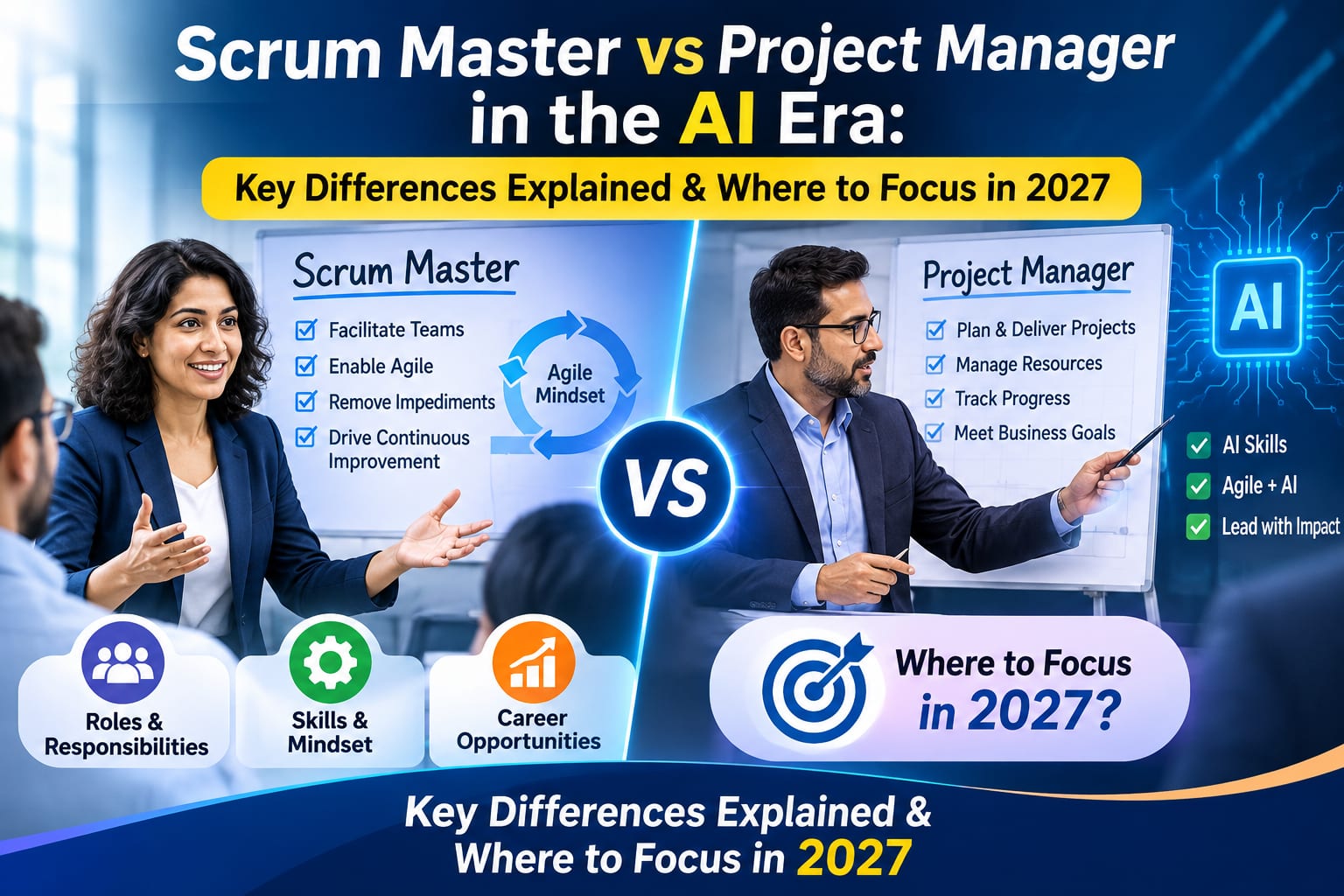
Quick answer: A Project Manager is accountable for delivering an agreed scope on time and within budget, and plans and directs the work. A Scrum Master is accountable for how well a Scrum team works: coaching, removing blockers and improving how the team delivers. In the AI era both roles are changing fast. AI now drafts status reports, schedules, risk logs and Sprint summaries, so the value of each role is moving to the parts AI cannot do: judgement, people and outcomes.
Scrum Master vs Project Manager: key differences
Scrum Master | Project Manager | |
|---|---|---|
Main goal | A team that delivers value every Sprint and keeps getting better | The agreed scope delivered on time, within budget and at the agreed quality |
Authority | No authority over people or tasks; leads through coaching and facilitation | Directs the plan, assigns work and manages resources |
Who decides the work | The Product Owner orders the backlog; developers decide how to do it | The Project Manager, with sponsors and stakeholders |
Planning | Short cycles (Sprints); the plan changes as the team learns | Often a full plan up front, with change control |
Success measures | Sprint goals met, steady flow of work, team health, fewer blockers | Milestones met, budget variance, scope delivered, risks controlled |
Typical framework | Scrum and Kanban; SAFe® in large companies | Waterfall, PRINCE2®, PMBOK®, hybrid or Agile |
What AI now does for them | Sprint summaries, meeting notes, board clean-up, flow metrics | Status reports, schedule updates, risk and issue logs, budget tracking |
Where the human value moves | Coaching, team dynamics, helping teams work well with AI | Stakeholder trust, trade-off decisions, governance and outcomes |
What does a Scrum Master do?
The Scrum Guide makes the Scrum Master accountable for the team's effectiveness. In practice:
Facilitates the Scrum events so they stay focused and inside their timebox.
Removes blockers the team cannot fix alone, such as a dependency on another team or missing access.
Coaches the team and the Product Owner on self-management, refinement and a clear Definition of Done.
Protects the team's focus by steering mid-Sprint requests to the Product Owner.
What does a Project Manager do?
Defines scope, schedule and budget with the sponsor, and gets them agreed.
Plans and assigns the work, and tracks progress against milestones.
Manages risks, issues and changes through a formal process.
Reports to stakeholders and is accountable for the outcome.
How AI is changing both roles
AI assistants such as ChatGPT and Microsoft Copilot, and the AI features now built into Jira and Confluence, are good at the administrative half of both jobs. They can write a status report from the board, summarise a Sprint Review, draft user stories, flag tickets that have not moved, and update a schedule after a delay. Work that used to fill a Project Manager's Friday afternoon now takes minutes.
That changes what employers pay for:
For Project Managers: less time on reporting and chasing updates, more on decisions. Which trade-off do we make when the vendor slips? Which risk matters most to the sponsor? AI can list the options, but a person has to choose and own the decision.
For Scrum Masters: less time on board hygiene and meeting notes, more on the team itself. Why does this team avoid conflict in retrospectives? How do developers use AI coding tools without lowering quality? How do we keep the Definition of Done meaningful when AI writes part of the code?
For both: teams now include AI tools as part of the way work gets done. Someone has to agree how the team uses them: what is reviewed by a human, what data must not be pasted into a public tool, and how AI-generated work is tested.
Neither role is going away. The parts of each role that are pure administration are shrinking, and the parts that need judgement, facilitation and trust are becoming the whole job.
Where to focus in 2027
If you are, or want to be, a Scrum Master:
Coaching and facilitation. Run retrospectives that lead to real change, and handle conflict calmly. This is the part AI cannot do.
Flow and metrics. Read cycle time, throughput and work-in-progress, and use them in conversations with the team, not as targets.
AI in the team's workflow. Help the team agree working rules for AI tools: review, testing and data privacy.
Scaling. Many large employers run SAFe®. Knowing PI Planning and how several teams coordinate opens more roles.
Proof of knowledge. We recommend the PSM I certification after hands-on practice. Read CSM vs PSM vs SSM vs SASM to compare options.
If you are, or want to be, a Project Manager:
Stakeholder management and negotiation. Building trust and agreeing trade-offs remain human work.
Decision-making with AI. Use AI to model options and draft reports, then check the output and make the call.
Hybrid delivery. Most organisations mix Agile teams with fixed milestones. Knowing both worlds makes you more useful.
Governance of AI use. Risk, compliance and data rules for AI tools are becoming part of project governance.
Can one person be both?
In Scrum there is no Project Manager role. The work is shared between the Product Owner, the developers and the Scrum Master. Many companies, especially in India and in services firms, still hire an Agile Project Manager or "Scrum Master cum Project Manager" who does both. That can work in hybrid set-ups, but the conflict is real: it is hard to coach a team to manage itself while also assigning its tasks. If you take a combined role, be clear which part you are doing at any moment.
Moving from Project Manager to Scrum Master
Project Managers already bring stakeholder management, risk thinking and delivery discipline. The hardest change is letting go of control:
From assigning tasks to asking questions: let the team decide who does what.
From a fixed plan to the Sprint goal: measure progress by working increments, not percent complete.
From status meetings to visible work: boards, burn-down charts and Sprint Reviews replace status reports, and AI can draft whatever summary stakeholders still need.
Interviewers can tell when a candidate only knows the theory. They ask situational questions such as: "Your manager wants each developer's hours for this Sprint. What do you do?" or "The team wants to use an AI coding assistant. How do you handle it?" Practise answers on real Scrum Master interview questions, or in a mock interview series with personal feedback.
Which role is right for you?
Choose Scrum Master if you enjoy coaching and facilitation, and you are comfortable leading without formal authority.
Choose Project Manager if you like planning, budgets and owning a delivery end to end, especially in regulated or fixed-scope work.
Choose Agile Project Manager if your target companies run hybrid delivery and you want to use both skill sets.
To learn the Scrum Master side hands-on, our Scrum Master / Agile PM Live Project Mentorship runs every Sprint event on a live JIRA and AI project, taught by Dhirender Verma, SAFe® Program Consultant (SPC), or an equivalently qualified trainer.